

Table of Contents
- What Makes a Wall Clock Minimalist?
- Why Silent Wall Clocks Matter in Quiet Rooms - No Tick Tock !
- Mid-Century Modern Wall Clocks: A Timeless Match
- Choosing a Large Minimalist Wall Clock for Impact
- Materials and Craftsmanship That Last
- How to Style Minimal Wall Clocks in Any Room
- Frequently Asked Questions
Last updated: October 1, 2026
What Makes a Wall Clock Minimalist?
Minimal Wall Clocks By Royale strip a timepiece down to its essentials: clean lines, restrained colour, and nothing on the face that does not need to be there. This guide from By Royale covers what separates a genuinely minimal design from a busy one, and how to choose a piece that lasts.
The distinction matters more than most buyers expect. A clock that reads as calm at arm's length can look cluttered from across a room, and the wrong finish will fight every other surface in the space.
Minimalism in wall clocks is not about owning less. It is about removing anything that competes for attention, so the shape and the material carry the design instead.
Three features do most of the work:
- Mid-Century Style. 1950s numerals, or thin markers at most. The hands should be the only moving element.
- A single, confident shape. A circle, a square, a starburst silhouette or an asymmetric shape.
- Restrained colour. Two tones at most, usually a pale face against a darker frame or the reverse.
Most people assume minimal means plain. It does not. A minimalist wall clock can be large, dramatic, and the focal point of a room, provided the drama comes from proportion rather than decoration.
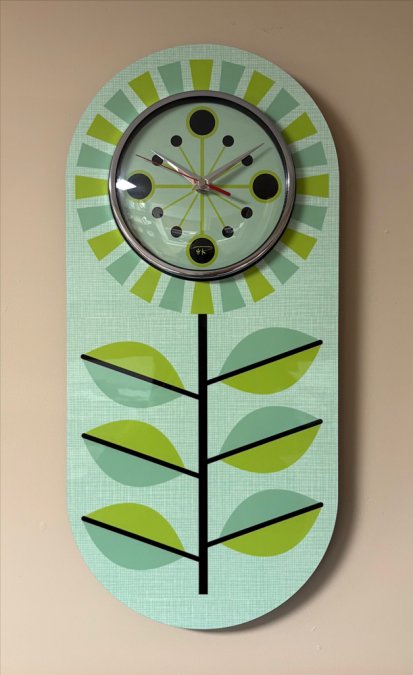
The Elysian Wall Clock in Mint Green By Royale
Why Silent Wall Clocks Matter in Quiet Rooms - No Tick Tock !
Silent wall clocks matter because a ticking movement is the one sound a room cannot absorb. Soft furnishings, rugs, and curtains deaden most noise, but a mechanical tick sits in the mid-range frequencies those materials do not touch.
Bedrooms and home offices feel the difference first. A clock in a hallway is background. The same clock two metres from a pillow becomes the thing you notice at 2am.
Sweep movements solve this by replacing the step-and-stop tick with a continuous glide. The trade-off is a slight draw on the battery, so expect to change it a little sooner than a standard quartz movement. That is a fair exchange for a room you can actually rest in.
Worth checking before you buy: some listings describe a clock as "silent" when they mean "quiet." Ask whether the movement is sweep or step. If the seller cannot tell you, that is your answer.
All of the clocks made By Royale are fitted with a Silent Quartz motor with a smoothe sweeping second hand.
Mid-Century Modern Wall Clocks: A Timeless Match
Mid-century modern wall clocks come from a specific moment in design history, and that origin is why they still work in contemporary interiors. The era's designers treated the clock face as a graphic problem, reducing it to circles, rays, and simple geometry.
That is also why the style sits so comfortably beside minimalism. Both approaches trust the shape to do the work.
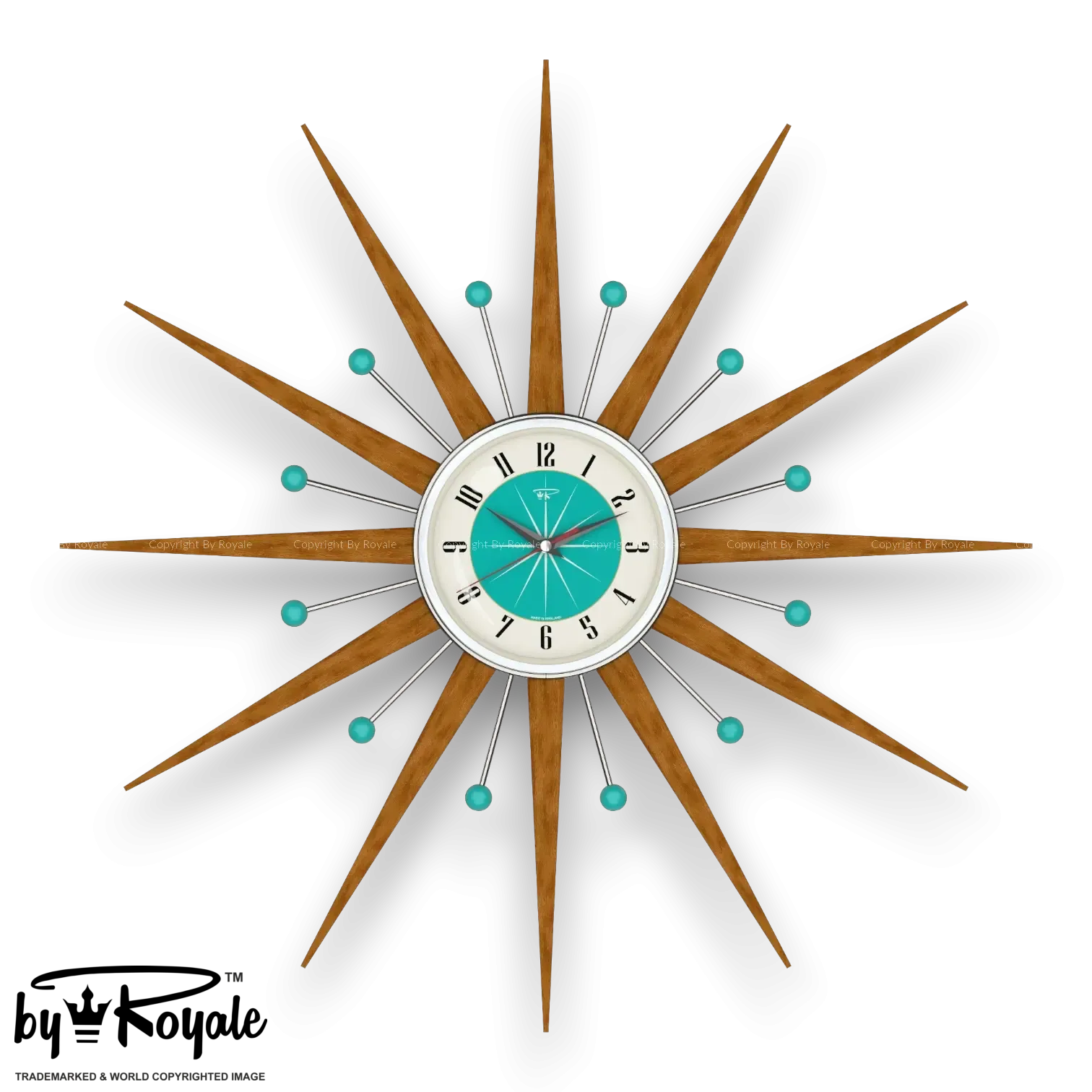
The most recognisable form is the Starburst Clock, a central dial with tapered solid Teakwood Rays radiating outward. Handcrafted versions often emphasise quality materials and construction in a way that mass production may not match.
What most buyers miss is that the materials age differently from modern substitutes. A genuine vintage laminate develops a soft patina over decades. A printed reproduction fades and lifts. If longevity is the point, ask what the piece is actually made from.
At By Royale, each piece is personally handcrafted by David in a studio workshop, with designs influenced by Mid-Century shapes and styles and utilising authentic materials from the 1950s and 60s.
Choosing a Large Minimalist Wall Clock for Impact
A large minimalist wall clock works when it is sized to the wall, not to the furniture beneath it. Too small and it reads as an afterthought, too large and it overwhelms the room.
Use the wall as your measure. A clock should occupy somewhere between a third and a half of the available width on the wall it hangs on. On a wide, empty wall above a sofa, that usually means going bigger than your first instinct.
Placement rules that hold up in practice:
- Hang the centre of the clock at eye level, roughly 1.5 to 1.6 metres from the floor.
- Leave at least 20 centimetres of clear wall on every side.
- Keep it off the same axis as a pendant light or ceiling fan.
- On a dark wall, choose a pale face. On a pale wall, a darker frame.
The scale question is where most rooms go wrong. A generous clock on a bare wall anchors the space. The same clock squeezed between two shelves looks like a mistake.
Materials and Craftsmanship That Last
Materials decide whether a clock is still on your wall in ten years. The movement is serviceable and replaceable. The body is not.
Solid timber, metal, and period-correct laminate hold up. Thin MDF with a printed veneer does not, particularly in rooms with fluctuating humidity. Look for a frame with visible grain or a consistent edge, not a printed pattern that stops at the corner.
Craftsmanship shows in the details you cannot see from the sofa:
- A dial printed on rigid stock rather than paper
- Hands that are balanced and do not wobble as they sweep
- A movement that is accessible for battery changes without dismantling the frame
- Consistent finish on the back, which tells you the maker cared about the whole object
Durability is the honest answer to the "will this last" question. A well-made clock is a piece you keep through a renovation, not a piece you replace when the style shifts.
How to Style Minimal Wall Clocks in Any Room
Styling minimal wall clocks is mostly about restraint. The clock is the statement, so everything around it should step back.
Living room: Hang it centred above the sofa, at least 20 centimetres above the backrest, keep the wall around it clear. One clock, one piece of art, nothing else on that plane.
Bedroom: Choose a sweep movement and a mid-size dial. Place it opposite the bed, not beside it, so you are not turning your head to read the time.
Home office: Position it in your line of sight from the desk chair. A minimal face is easier to read at a glance than an ornate one, which matters when you are trying not to lose focus.
Hallway or entry: This is where a larger, bolder piece earns its place. A Starburst Clock or an oversized dial works well here because the space is transitional and can carry more visual weight.
Kitchen: Go smaller and wipeable. Steam and grease are hard on finishes, so keep the piece away from the hob.
The throughline across every room is the same: give the clock its own wall space, and let the rest of the scheme stay quiet.
Choosing a wall clock that still looks right after a decade can be harder than it sounds. By Royale handcrafts Mid-Century modern Wall Clocks, Lamps, Plant Stands and Wall Art using authentic materials from the 1950s and 60s, with custom Royalexe™ Laminate and Starburst designs available, and worldwide delivery. Get started with By Royale and explore statement pieces for your home.
Frequently Asked Questions
What defines a minimalist wall clock?
A minimalist wall clock strips away numbers, ornate hands, and decorative frames. It focuses on clean lines, a simple face, and often a single accent like a slim bezel or a starburst motif. The goal is to tell time without visual clutter, so the clock blends into the room rather than dominating it. Look for uncluttered dials, subtle hour markers, and a restrained colour palette.
Are silent wall clocks better for bedrooms?
Yes. Silent wall clocks use a sweeping quartz movement instead of a ticking one, so there is no audible click. In bedrooms, studies, or nurseries, that quiet operation helps maintain a calm environment. If you are a light sleeper or use the room for focused work, a silent mechanism is worth seeking out. Many handcrafted clocks now come with silent movements as standard.
How do I choose the right size wall clock for my living room?
As a rule of thumb, the clock's diameter should relate to the width of the furniture below it, such as a sofa or console, so that it feels proportionate rather than cramped or lost on the wall. Always measure your wall first and mark the position with tape before committing.
Do minimalist wall clocks fit with Mid-Century Modern decor?
They are a natural fit. Mid-Century Modern design favours clean geometry, organic shapes, and uncluttered surfaces. A minimal clock with a starburst or sunburst profile, or a simple round face with tapered hands, echoes that era without looking dated. Materials like walnut, teak, and brass are common in both minimal and mid-century pieces, so the two styles often overlap.